
Emma Jones
Published:
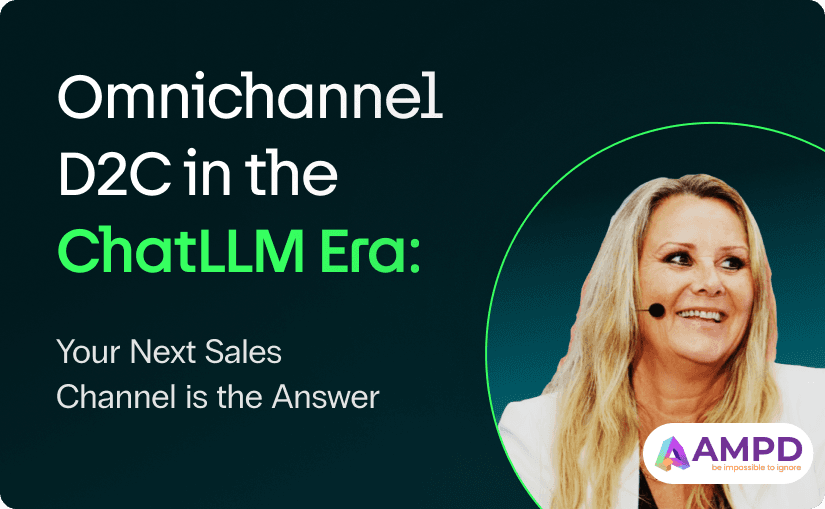
Your Next Sales Channel is the Answer
For omnichannel D2C brands, growth has always depended on managing the customer journey across multiple touchpoints: eCommerce websites, marketplaces, social commerce, retail partners, reviews, influencers, PR, product feeds, paid media and customer service. Now there is a new touchpoint influencing discovery and purchase are the ChatLLM citations increasing the fragmentation in the customer journey.
Customers are no longer only searching Google, scrolling TikTok, browsing marketplaces or visiting brand websites. They are asking ChatGPT, Gemini, Perplexity, Claude, Copilot, Meta AI, Mistral, DeepSeek and Grok what to buy, which products suit their needs, which brands are trusted, and where they should purchase.
That changes the commercial question from, “Are we present across every channel?” to “Are our digital touchpoints strong enough for ChatLLMs to cite us?”
For omnichannel D2C brands, GEO and AEO are part of the sales infrastructure. ChatLLMs now influence which products are discovered, compared, trusted and shortlisted before a customer ever reaches the checkout.
ChatLLMs are Already Part of the Omnichannel Journey
A customer may see your product on Instagram, check reviews on Trustpilot, compare it on Amazon, look at TikTok Shop, visit your website, watch a creator video, read a PR article, then ask ChatGPT or Gemini:
“Which brand is best for sensitive skin?”
“What is the best alternative to this product?”
“Which retailer has the most reliable delivery?”
These are not simple searches but potential customer prompts with high purchase intent. ChatLLMs compare, summarise and cite based on the information they can retrieve from across the digital ecosystem. Your product pages, marketplace listings, reviews, social proof, PR, video transcripts, customer service content and product data all become signals. If those signals are inconsistent, outdated or weak, ChatLLMs may cite a competitor instead.
Marketplaces are Already Moving into ChatLLM Commerce
Walmart has partnered with OpenAI to create AI-first shopping experiences, enabling customers to shop through ChatGPT using Instant Checkout. Etsy has also partnered with OpenAI, allowing US ChatGPT users to discover, browse and purchase from Etsy sellers inside ChatGPT. Target has launched a Target app experience in ChatGPT to help customers find curated options, purchase products and choose fulfilment options. Allegro has announced collaboration with OpenAI to develop AI-driven eCommerce solutions.
For D2C brands, this matters because marketplaces are no longer just places to list products, but they are becoming discovery environments for ChatLLMs. The next battle is not only being on the marketplace at the top, but whether ChatLLMs cite your brand or product when the customer asks what to buy.
Shopify, Stripe, Google UCP & Social Selling are Pulling D2C Commerce Closer to ChatLLMs
Shopify is also moving closer to ChatLLM commerce. OpenAI announced Instant Checkout in ChatGPT with Etsy and Shopify, supported by the Agentic Commerce Protocol co-developed with Stripe. The purpose of ACP is to give agents, merchants and payment providers a common language for completing purchases while keeping the merchant in control of fulfilment, returns, support and the customer relationship.
Google is moving in the same direction with Universal Commerce Protocol (UCP), which they describe UCP as an open standard for agentic commerce, designed to help AI Mode in Search and the Gemini app support shopping actions, including direct buying. Google has also said it is simplifying UCP onboarding through Google Merchant Center, which means product data, merchant feeds and structured eCommerce information will become even more important for brands that want to be surfaced inside Gemini and Google AI shopping experiences.
For D2C brands, the direction is clear. ChatGPT has ACP. Google has UCP. Marketplaces are collaborating with ChatLLMs. Payments, product discovery, checkout and post-purchase journeys are starting to connect into agentic commerce systems.
Social selling also becomes more important in this environment. TikTok Shop, Instagram, creator content, YouTube reviews, Reddit threads and customer comments are not just awareness channels; they are public signals that shape how ChatLLMs understand product demand, sentiment, use cases and trust. A product going viral may create attention, but ChatLLM citations will depend on whether that attention is supported by clear product data, consistent descriptions, credible reviews, useful transcripts, PR, backlinks and proof across the wider digital ecosystem.
In other words, social selling creates the conversation, but structured evidence helps ChatLLMs decide whether the product is credible enough to cite.
Omnichannel Consistency Now Means Citation Consistency
Most D2C brands already know how difficult it is to manage multiple channels with inconsistent data for product or digital assets across different platforms, which causes fragmentation to a ChatLLM. If product names vary, claims are not evidenced, images, delivery details are unclear, or marketplace listings do not match the brand website, ChatLLMs may struggle to understand which version to trust.
This is why omnichannel management now has a new requirement called citation consistency. Every digital touchpoint needs to reinforce the same story: what the product is, who it is for, why it is relevant, where it can be bought, and what proof supports the claim.
Different ChatLLMs Behave Differently
There is no single ChatLLM algorithm and this makes optimisation fragmented.
ChatGPT may favour well-structured brand authority and conversational usefulness whereas Gemini may lean into Google’s ecosystem, shopping data and fresh web signals. Perplexity often prioritises cited, retrievable sources but Claude may favour clear context and evidence. Copilot is often used by enterprises and may reflect Microsoft’s business environment, yet Grok and MetaLlama, DeepSeek and Mistral are preferred by smaller, independent users and may behave differently again depending on platform, market, language and source availability.
That means a product may appear in one ChatLLM answer but not another. It may be cited in English but not in French. It may appear for a brand prompt but disappear when the customer adds price, delivery, marketplace, use case or location.
The Four Layers of ChatLLM Citation Visibility
D2C brands should approach ChatLLM citation visibility through four layers: Entity, Knowledge & Training, Retrieval & Processing, and Decision & Citation.
Layer 1: Entity. Does AI Know Who You Are, What You Sell & Where You Sell?
The ChatLLMs needs to clearly understand your brand, product range, category, customer fit and crossborder international markets.
Consistency is key across your business name, brand and product name. Ensure category descriptions are consistent, detail delivery options per market and ensure returns policies are localised per country. Do not skimp on localising your website content neither your social media content nor your PR and backlinks.
If the ChatLLMs cannot clearly identify your business, brand, hero products, countries served, customer proposition and proof points, it is unlikely to recommend you confidently.
AMPD helps identify whether the ChatLLMs understand your current entity status across 10 platforms.
Layer 2: Knowledge & Training. What Are You Teaching AI About Your Products & Customers?
This does not mean directly training ChatGPT or Gemini, but it does mean creating clear, credible and market-specific information across trusted digital touchpoints so ChatLLMs understand your brand, products and international relevance via trusted 3rd party sources.
For D2C brands, this includes social media, customer reviews, influencer content, film and video transcripts, PR, and directories.
AMPD helps surface the prompts, questions and content gaps that matter most for AI visibility and customer decision-making.
Layer 3: Retrieval & Processing. Can AI Find & Use Your Product Information?
Good content is not enough if AI cannot read, retrieve or process it. Your product data must be clear, structured and machine-readable. E-E-A-T metrics do still matter here for trust and authority, as well as schema structured data, JSON files, semantics and relevance, chunking and structure, trust.
If important information is hidden in images not indexed, PDFs, campaign videos without a transcript or unstructured product feeds, social content not tagged, the ChatLLMs may overlook it and cite a competitor with clearer data.
For cross-border D2C brands, every core market should have content that can be extracted and understood including country page sub directories, localised product catalogues, delivery information, returns rules, payment options, product suitability, local proof, customer reviews, dedicated social pages and FAQs.
AMPD helps assess whether your content, product data and technical structure are ready for AI retrieval and citation.
Layer 4: Decision & Citation. Are You Credible Enough to be Recommended?
This is where AI visibility becomes revenue. The ChatLLMs do not only need to understand what you sell, they need enough confidence to recommend your brand over competitors.
That confidence comes from evidence: verified customer reviews, local testimonials, PR, trusted backlinks, creator validation, product comparisons, certifications, delivery clarity, customer service signals and transparent returns policies. A brand that says “we ship internationally” is less useful than one that clearly explains delivery times, duties, returns, payments and support in each market.
Freshness of content is also a major factor. Everytime content is updated on your website ensure this is date stamped and authored.
AMPD tracks where your brand is cited, how often, in what position, with what sentiment, and against which competitors, helping you understand what needs to improve.
What Omnichannel D2C Brands Should do Now
The immediate priority is to understand how your brand and products appear inside ChatLLM answers across platforms, channels, marketplaces and languages.
Start with three questions:
1. Which prompts do we want to be cited for?
2. Do ChatGPT, Gemini, Perplexity, Claude and Copilot cite our products or competitors?
3. Which platform(s) is our ideal customer profile using
AMPD helps businesses measure ChatLLM citation visibility by business, brand, and product across 10 ChatLLM platforms in 18 languages.
For omnichannel D2C brands, the next advantage will not come from simply being everywhere. It will come from making every touchpoint clear, consistent and credible enough for ChatLLMs to cite.
——
Written by
Emma Jones
Founder & CEO, AMPD
hello@ampdaxo.com
Author of ‘Cracking the Code: AIO/GEO/AEO - Generating Sales Leads through ChatGPT and more.
Emma Jones
Founder & CEO
Related Reading


Let’s talk Neuro.